

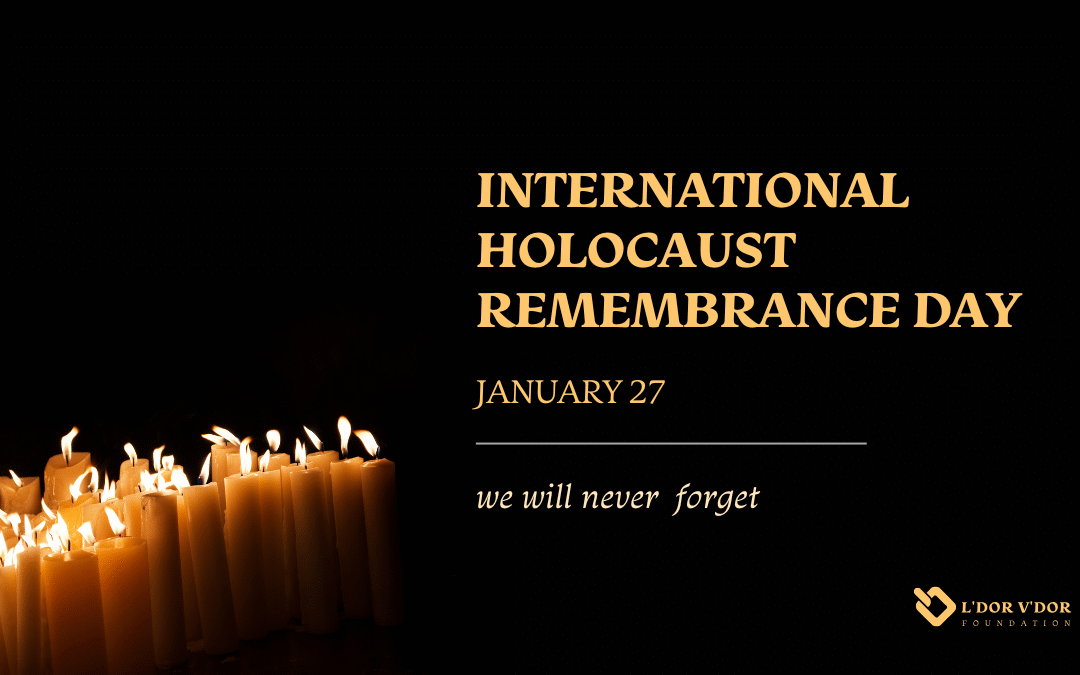
A name is never “just” a name. In Jewish life, we speak names aloud. We light a candle. We mark a yahrzeit. We carry memory forward—l’dor v’dor, from generation to generation.
On January 27, the world observes International Holocaust Remembrance Day (formally designated by the United Nations as the International Day of Commemoration in memory of the victims of the Holocaust). The date marks the liberation of Auschwitz-Birkenau in 1945.
For many people, remembrance can feel abstract—something we “should” do, but aren’t always sure how to do. At LDVDF, we approach remembrance in a distinctly Jewish way: by returning to names, to stories, and to the lived experiences of the people who came before us. Because when you know your ancestors—their trials and triumphs—you understand something essential about who you are today.
As you read, consider one name or story you’re carrying today. At the end of this post, you’ll have an option to share a brief reflection (publicly on social, or privately via a short form—no site comments).
International Holocaust Remembrance Day: More than a date on the calendar
International Holocaust Remembrance Day is a moment for the world to pause and remember. But for Jews, it also fits into a much older rhythm: memory as a sacred responsibility.
Remembrance is not only about grief. It’s also about identity—about refusing erasure. The Shoah (Hebrew, “the catastrophe”) targeted Jewish existence itself. When we preserve names and stories, we are doing more than looking back. We are carrying Jewish life forward.
Zakhor: memory as a Jewish practice
Just as musical themes in a film can bring a character or moment rushing back, memory is a recurring theme in Judaism—woven into our rituals, our language, and even our names.
- We observe a yahrzeit (Yiddish, “year-time”)—saying a loved one’s name in synagogue and lighting a 24-hour memorial candle at home.
- We speak of the deceased as “of blessed memory” and say, “may their memory be for a blessing.”
- Our Hebrew names carry ancestry. A traditional Hebrew name includes a parent’s name—Rivka bat David v’Pnina (Rebecca, daughter of David and Pearl)—a built-in reminder of the generation that came before.
- Naming traditions link generations. In many Ashkenazi families, a baby is named in honor of a deceased relative; in many Sephardi families, a baby may be named in honor of a living relative. Either way, a name is a bridge.
And again and again in Torah we encounter the command zakhor—remember. Even Rosh Hashanah is described as Yom HaZikaron, the Day of Remembrance. Jewish memory is not passive; it is something we practice.
Why remembering feels especially urgent now
Remembering the Holocaust is always necessary—and in our time, it can feel especially urgent.
Holocaust denial and distortion attempt to rewrite history with hearsay, assumptions, and falsehoods. But the record is overwhelming: survivor testimony, diaries and memoirs, documentation from liberators, extensive archives, and photographs and film footage—sometimes even created by the Nazis themselves.
More than 80 years after the end of World War II, we are still learning from survivor accounts and from the people who supported and rescued them. Every year, as fewer survivors remain with us, the responsibility shifts more heavily onto the rest of us: to remember clearly, to teach honestly, and to preserve names and stories with care.
From numbers to names: who was targeted
The Holocaust was the Nazi genocide of 6 million Jews—men, women, and children. The Nazi regime and its collaborators also persecuted and murdered millions of others. Estimates vary by source, but groups systematically targeted and killed included:
- Soviet prisoners of war
- Non-Jewish Polish civilians
- Roma and Sinti
- People with disabilities
- Serb civilians (particularly in areas under Nazi-allied regimes)
- And others persecuted and murdered, including gay men, Jehovah’s Witnesses, dissenting clergy, political opponents, and those who hid or otherwise aided Jews
When these victims are included, it is estimated that 13 million people were murdered.
Numbers matter because they help us grasp the scale of what happened. But numbers can also numb us. This is where Jewish memory offers a corrective: behind every number is a name. And behind every name is a story.
As Dr. Sima Velkovich of Yad Vashem notes:
“Behind every number is a person with a name, a life, and a story. Each time we recover a name through testimony or historical records, we restore identity and strengthen the chain of remembrance from generation to generation.”
—Sima Velkovich, PhD, The Head of the Family Roots Research Section, Yad Vashem, Jerusalem
This is why Jewish remembrance is not only something we feel; it is something we do: we speak names, preserve stories, and pass them forward.
Why names matter: identity, dignity, and continuity
A name is a symbol—and naming is one way we recognize a person as distinct, irreplaceable, and worthy of being remembered. This matters for Jewish identity, and it also matters for oral history: the first-hand accounts that preserve a family’s story.
In my husband’s family, there’s the story of his great-grandfather Nahum D.—a noteworthy yeshiva scholar—who eloped with Breindle A., a daughter of the Grand Rabbi of Kiev, moved with her to New York City, and later where he became an atheist. Is every detail accurate? There are clues that at least parts of it are. But even if the story has blurred edges, it does something powerful: it keeps names alive. It keeps family history present. It reminds later generations that our ancestors were complex human beings who made choices, endured upheavals, and built new lives.
This is one of the quieter ways identity forms: not only through what we believe, but through what we carry.
“Say their names”: a Jewish instinct older than hashtags
Long before modern hashtags reminded the world to speak names aloud, the Bible itself preserved names—often with genealogical detail. Sometimes it’s a brief identifier; sometimes it’s an extended list of children and ancestors. Either way, the pattern is clear: names are a way of memorializing heritage.
One dominant hypothesis is that many biblical narratives were transmitted orally for generations before being written down. That means, in a real sense, Jewish history was carried by people telling—and retelling—stories with names attached.
In more recent times, many families keep genealogical information at the front of a family Bible or in a folder tucked into a drawer. War-related monuments with names, census records, military registration, yizkor books, and immigration documents are all bridges across time and space. They make the past more present—and more meaningful.
Bridging generations: how to mark International Holocaust Remembrance Day in a Jewish way
This day calls us to remember—but it also invites us to do something practical with remembrance. If you’re not sure where to begin, here are a few simple options that connect Holocaust remembrance to Jewish identity and family history.
If you have 10 minutes
- Light a memorial candle. If you know a name, say it aloud. If you don’t know a name yet, say: “For those whose names were stolen, may their memory be for a blessing.”
- Write down three family surnames (and any town names you’ve heard). Don’t worry about spelling—variations are part of the process.
If you have 30 minutes
- Ask one relative one question: “Who are we named after?” or “What stories did your parents/grandparents tell about the old country, the war years, or immigration?”
- Preserve one story. A 3-minute voice memo counts. A paragraph in a notes app counts. The goal is continuity.
- Search one name in a Holocaust-era database (even if all you have is a surname and a region). Save what you find and come back to it later.
If you want to go deeper
- Visit a Jewish museum or Holocaust memorial museum (in person or online). According to The Jewish Museums Project directory, there are Jewish museums and Holocaust memorial museums worldwide—often in places you may not expect. Each one can be a doorway into history, education, and sometimes even archival discovery.
- Explore a yizkor book connected to your family’s town, if you know it. These community memorial books can contain names, photos, and stories that are nowhere else.
- Fill out a Page of Testimony or be part of the IRemember Wall project at Yad Vashem. Yad Vashem (Hebrew, “a memorial and a name”), the World Holocaust Remembrance Center, offers a variety of ways to be more involved.
One small act done sincerely is a bridge. And bridges are how memory becomes identity.
Did you do one small act today?
Light a candle. Say a name. Record a memory.
If you’d like, share one name or a short reflection using our story form (2 minutes).
Resources to further your genealogical journey
If you feel ready to learn more—or if you want to start building a clearer picture of your family’s story—these resources can help:
- YIVO Institute for Jewish Research — Explore archives, library holdings, and research resources documenting East European Jewish history and culture.
- Yad Vashem – Central Database of Shoah Victims’ Names — Search names and related records (including Pages of Testimony) to turn family questions into identifiable people and places.
- The Jewish Museums Project – Directory — Find Jewish and Holocaust museums and cultural organizations worldwide for education, exhibits, and local archival leads.
- European Holocaust Research Infrastructure (EHRI) – Portal — Discover Holocaust-related archival material across institutions through a single research portal and network.
A question to carry forward
How will you mark International Holocaust Remembrance Day this year?
Will you light a candle? Speak a name? Record a story? Search for an ancestor? Share what you learn with a child, a grandchild, a niece or nephew, a student, or a friend?
Remembrance is not only about the past. It’s about what we choose to carry into the future—together.
If you’d like to mark this day with us, share one name you’re carrying—or a brief reflection.
You can respond publicly on our social post (LinkedIn/Facebook/Instagram/X), or share privately through our short “Letter to LDVDF” form. With your permission, we may publish an excerpt in our quarterly Letters to LDVDF roundup (3–5 short reflections).
LDVDF exists to help Jewish memory live. If you’re beginning (or continuing) a family-history journey and want support recovering names, places, and stories, we invite you to connect with us, explore our resources, or get involved as a volunteer.
May their memory be for a blessing—and may our remembering strengthen Jewish life for generations to come.
###
About L’Dor V’Dor Foundation
The L’Dor V’Dor Foundation (LDVDF) rescues Jewish memory and makes it accessible to everyone. Through its flagship Documentation of Jewish Records Worldwide (DoJR) project, LDVDF is building JCat, a massive, free, online catalog of historical documents of Jewish lives – Ashkenazi, Sephardi, Mizrahi, Crypto‑Jewish, Rabbinic, and more. By discovering and describing every record collection we can find, LDVDF helps ensure that Jewish heritage can be found, studied, and passed from generation to generation.
Rescuing our lost history and changing lives — from generation to generation.
About the Author
Lisabeth (“Lisa”) Dashman, PhD, is a volunteer writer with the L’Dor V’Dor Foundation (LDVDF) with extensive experience in marketing communications across corporate and nonprofit organizations. Guided by a deep interest in linguistics and the way language carries culture and memory, she pursued her PhD in Anthropology alongside an MBA in Technology Management. In her monthly LDVDF posts, Lisa combines research rigor with practical storytelling to help readers preserve Jewish names, records, and family stories from generation to generation.