

This Jewish heritage news digest is this week’s NewsNosh (The Weekly News Nosh) from L’Dor V’Dor Foundation—a curated set of links for anyone interested in Jewish family history, Jewish history, and Jewish heritage. This week’s NewsNosh Jewish heritage news digest includes RootsTech 2026’s free “Relatives at RootsTech” discovery experience, JewishGen’s Memorials & Plaques Database milestone topping 360,000 records, AutoKinship’s new ways to build family trees from your DNA matches, and more.
Editor: Phil Goldfarb, Tulsa, Oklahoma, USA
This week’s news links:
- RootsTech 2026 Opens Virtual Discovery Experience Ahead of Event. RootsTech 2026 by FamilySearch has opened Relatives at RootsTech, its popular annual online family discovery activity. Hundreds of thousands of people are expected to participate globally, with the aim of making new cousin connections. Anyone can join the experience for free at: See all the people you’re related to It will be available through the end of March 2026.
- JewishGen’ s Expanded Memorials & Plaques Database Grows to More than 360,000 Records. This update added approximately 13,000 records and 4,000 photos from 32 sources worldwide. This update brings the Memorials & Plaques Database holdings to more than 360,000 records and 243,000 photos from 900 synagogues, institutions and memorials representing 57 countries. For a list see: JewishGen Memorial Plaques Database – Inventory To search, go to: JewishGen Memorials & Plaques Database
- From Records to Narratives: How AI is Breathing Life into Genealogy. How do we bridge the gap between a spreadsheet and a story? The answer lies in a new, collaborative workflow using Artificial Intelligence. By using AI as a research partner rather than a ghostwriter, you can transform fragmented records into meaningful narratives. Here is the step-by-step method to bring your ancestors into the light. Read more from Next Genealogy: From Records to Narratives: – by Carole McCulloch
- AutoKinship by Genetic Affairs Builds Family Trees from Your Matches at FamilyTreeDNA, and More. A long and detailed story from DNA Explained: AutoKinship by Genetic Affairs Builds Family Trees from Your Matches at FamilyTreeDNA, and More | DNAeXplained – Genetic Genealogy
- The Jewish Paul Revere. The forgotten story of Francis Salvador, the Jewish Founding Father of America. Salvador became the first Jew to hold elective office in the Americas and the first Jew to die for the American Revolution. Read his story from Aish: The Jewish Paul Revere | Aish
- One Sephardi Jew Against an Empire. The extraordinary story of Samuel Pallache, a Jewish privateer. He became a Jewish Diplomat in a divided Europe as Amsterdam offered a rare political environment in which Jews could live openly and practice Judaism without fear of persecution. Read his story from Aish: One Sephardi Jew Against an Empire | Aish
- The Auschwitz Survivor Who Became a Wall Street Legend. Five powerful lessons from the life of Siggi Wilzig. Read his story from Aish: The Auschwitz Survivor Who Became a Wall Street Legend | Aish
- The man who personally saved the lives of 1,000 musicians. Bronislaw Huberman was an infant prodigy who, by the time he was 12, had played Brahms on his violin… er… to Brahms. Read his story from the Jewish Chronicle: The man who personally saved the lives of 1,000 musicians – The Jewish Chronicle – The Jewish Chronicle
- What Is the Temple Mount? Holy to both Jews and Muslims, the Temple Mount, known in Hebrew as Har Habayit, is traditionally said to be the site where Abraham demonstrated his devotion to God by taking his son Isaac to be sacrificed. The mount is also the site of both ancient Jewish temples. Read the story from My Jewish Learning: What Is the Temple Mount? | My Jewish Learning
- Roman Emperor Marcus Aurelius and the Jews. Stoic philosopher-ruler Marcus Aurelius left a surprising imprint on Jewish history and philosophy that continues to be felt today. Read his story from Aish: Roman Emperor Marcus Aurelius and the Jews | Aish
- Olympics T-shirt marking 1936 Berlin Games raises eyebrows. T-shirts on the Olympics online store commemorating past venues include one for the 1936 Games in Berlin. Nazi Germany hosted both the Winter and Summer Olympics that year, as it was starting to ramp up its repression. Read the story: Olympics T-shirt marking 1936 Berlin Games raises eyebrows
- The one-time synagogue in Novorossiysk, Russia is slated for restoration. Constructed in 1908, the imposing building with a triple arched entryway and large dome was used for worship only until 1928, when it closed by the Soviet authorities. It currently serves as the city’s Center of National Cultures. Read the story from Jewish Heritage Europe: https://jewish-heritage-europe.eu/2026/02/12/russia-novorossiysk/
- Jewish Aramaic. The language of the Talmud, Jesus and today’s Jewish Kurds. The Aramaic language has been around for over 3,000 years, beginning in the 11th century B.C.E as the official language of the first Aramean states in Syria. Read more from My Jewish Learning: Jewish Aramaic | My Jewish Learning
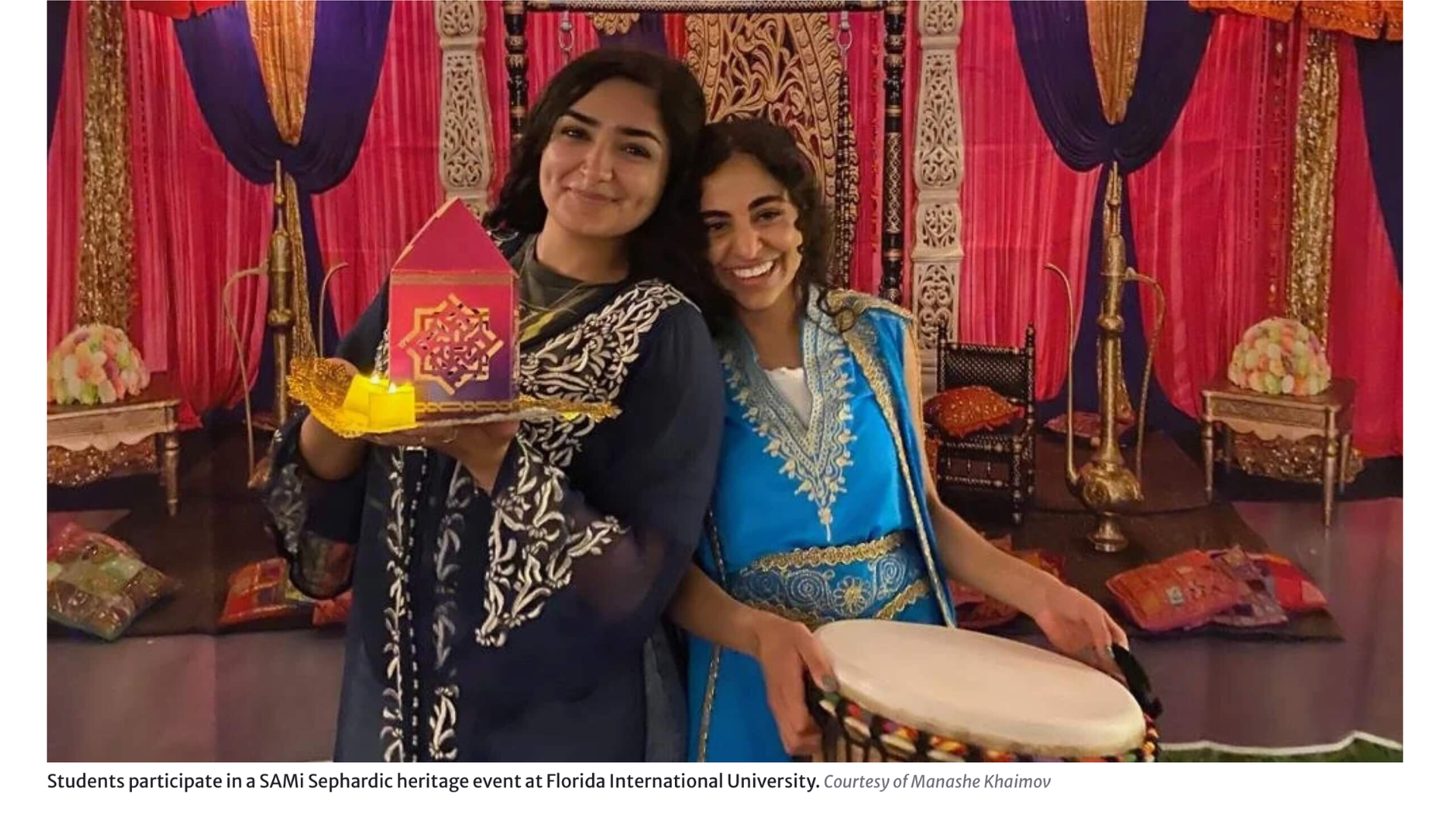
- Muslim and Sephardic Jewish college students are connecting over shared heritage. Amid campus tensions, participants in Mizrahi cultural events say shared food, language and other commonalities are creating unexpected connections. Read more from The Forward: Sephardic and Muslim students find common ground in culture – The Forward
- Why is Hebrew Written from Right to Left? Most languages are written from left to right. Hebrew is one of the exceptions. Have you ever wondered why? Scholars theorize that it has to do with the medium in which the language was originally written. Read more from My Jewish Learning: Why is Hebrew Written from Right to Left? | My Jewish Learning
- From The Forward Archives: A Very Yiddish Valentine’s Day. Valentine’s Day, despite being largely secularized in America, is a Catholic holiday that honors a third-century Roman Saint. The February 14, 1928 issue of the Forward featured an ad in the form of a heart-shaped Valentine’s Day card touting the benefits of Sheffield Farms’s milk for babies. The idea of a Valentine’s Day card was so foreign to Forward readers that the ad describes such a card simply as a geshank, or gift. Read the full story from The Forward: Valentine’s Day, Yiddish-Style
- This Early Yiddish Film Is a Rare Piece of Jewish Cinematic History. To witness a movie like “Al Khet” (“I Have Sinned”) is akin to observing a religious rite or holiday. Read the story from Hey Alma: This Early Yiddish Film Is a Rare Piece of Jewish Cinematic History – Hey Alma
- The Meaning of 7 Common Jewish Words. A deeper look behind some common Jewish words like chutzpah, oy vey and yarmulke. Read more from Aish: The Meaning of 7 Common Jewish Words | Aish
###
About The Weekly News Nosh
The Weekly News Nosh (NewsNosh) is the L’Dor V’Dor Foundation’s weekly Jewish heritage news digest—a curated set of links for anyone interested in Jewish family history, Jewish history, and Jewish heritage. NewsNosh is published on Sundays and shared on our website and social media platforms. “A Family Without The Understanding Of Their Past History, Foundation And Ethnicity Is Like A Tree Without Roots.” Subscribe to receive NewsNosh every Sunday, directly in your inbox. Browse past issues of our Jewish heritage news digest in the NewsNosh archive.