

Roots & Revelations: Field Notes is a monthly series from L’Dor V’Dor Foundation exploring Jewish heritage, memory, and the stories we carry forward.
Every Haggadah tells the same story—or does it? Every seder retells the Exodus, but every Haggadah also records what a family or community wants to remember, question, and pass on.
Haggadot Through the Ages
Storytelling is as old as humankind. For Jews, one story retold every year is our journey from slavery to freedom in Egypt. That is the central story of the Haggadah (plural: Haggadot). The word itself comes from the Hebrew for “telling.” It names the text that sets forth the order of the Passover seder. But how a Haggadah tells the tale—that is a different story.
Styles range from illuminated manuscripts to graphic novels, from handmade versions created for individual families to the enduring Maxwell House booklet, first distributed in 1932. The National Library of Israel describes its Haggadah holdings as the world’s largest collection of its kind, numbering in the thousands. Surviving handwritten Haggadot go back at least to the 12th century.
The core order of the seder appears in rabbinic sources such as Mishnah Pesachim, compiled around 200 CE, even though the Haggadah kept evolving for centuries afterward. Since then, editors, artists, translators, and families have shaped the text in the language and style that felt right for their own tables.
A Key Role for Children
Few Jewish ritual texts make children’s participation as visible as the Haggadah does. Traditionally, a child at the seder asks the Four Questions; in many homes, the youngest takes that role, opening a conversation about how and why this night is different from all other nights.
Later in the evening, many homes invite children to help find the afikomen, the piece of matzah eaten near the end of the meal in memory of the Passover sacrifice. The hide-and-seek aspect is a custom rather than a universal requirement, but its purpose is clear: to keep children engaged, curious, and awake long enough to enter the story for themselves.
Who has not heard a child implore, “Tell me a story!” Storytelling teaches culture and carries memory. My youngest child still recalls the year she lobbied to include in our Haggadah a reading for the millions of non-Jews persecuted and murdered by the Nazis. My eldest child remembers when we began varying our Passover menu to reflect recipes from places family members had traveled during the previous year. This year, the theme is Mexico and Brazil. The Haggadah makes room for those additions, turning a ritual text into a living record of what matters to the people around the table.
A Haggadah for Every Home
The Haggadah is more than a story with a happy ending. Although it is structured with a beginning, a middle, and an end, it contains numerous opportunities to ask questions and create memories—another reason every generation matters at the seder table. L’dor v’dor.
In this way, each Haggadah reflects the time it was made and the values of its makers. Over time, printed editions, illustrations, melodies, and local customs all left their mark. As the seder moved through Jewish communities—from Spain and North Africa to Iraq, Iran, Europe, and the Americas—the telling absorbed local languages, melodies, and food traditions. That is part of what makes the Haggadah so enduring: it is shared across the Jewish world, but never quite identical from one table to another.
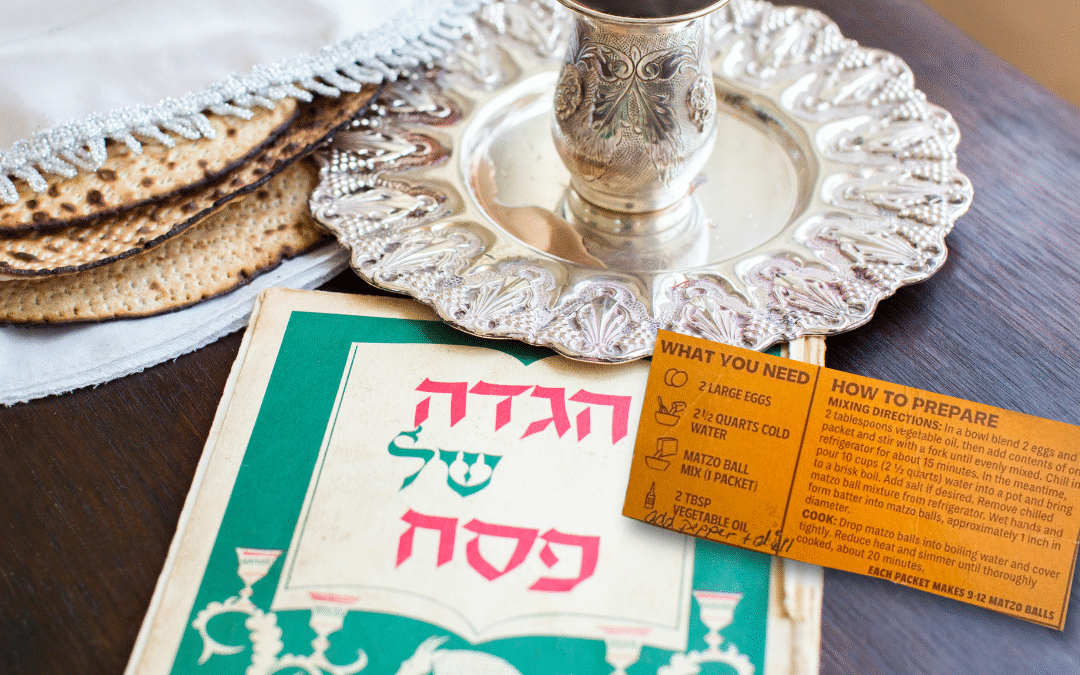
Rather than functioning as a closed script, the Haggadah has long invited commentary, elaboration, song, and local custom. Retelling the story strengthens collective memory from generation to generation while also making room for individual memory. Handwritten notes in the margins—a date, a guest list, a question from a child, a favorite melody, a menu, or a remembrance of someone no longer at the table—can turn a Haggadah into a family archive.
This year, we are giving the women in our Haggadah a bigger role. The baby found on the banks of the Nile, for example, is named Moses by Pharaoh’s daughter in Exodus; later Jewish tradition often identifies her as Bithiah. That detail is a reminder that women help carry this story from danger to deliverance, and from text to table.
Resources
If you have 10 minutes:
- If your family has a homemade Haggadah, find out who created it and when.
- Ask a child at your table to explain what Passover is about. Write down the answer—you may be surprised.
- Explore how Passover is celebrated around the world.
- Compare charoset/haroset traditions from different Jewish communities.
If you have 30 minutes:
- Browse Seder Stories for children’s books about Passover.
- For a classic American Jewish example, revisit All-of-a-Kind Family.
- Compare Sefaria’s Ashkenaz and Edot HaMizrah Haggadot.
- Ask a relative for a favorite seder recipe. Many communities treasure versions of charoset/haroset or another Passover dish.
- Look through a family or communal Haggadah for inscriptions, margin notes, or dedications. Those small handwritten traces often tell a story of their own.
- Browse the National Library of Israel’s online Haggadah exhibition.
Chag Pesach Sameach!
Want future posts from Roots & Revelations: Field Notes and more Jewish heritage resources? Subscribe here.
LDVDF exists to help Jewish memory live. If you’re beginning or continuing a family history journey and want support recovering names, places, and stories, we invite you to connect with us, explore our resources, or get involved as a volunteer.
May their memory be for blessing, and may our remembering enhance Jewish life for generations to come.
###
About L’Dor V’Dor Foundation
The L’Dor V’Dor Foundation (LDVDF) rescues Jewish memory and makes it accessible to everyone. Through its flagship Documentation of Jewish Records Worldwide (DoJR) project, LDVDF is building JCat, a massive, free, online catalog of historical documents of Jewish lives – Ashkenazi, Sephardi, Mizrahi, Crypto‑Jewish, Rabbinic, and more. By discovering and describing every record collection we can find, LDVDF helps ensure that Jewish heritage can be found, studied, and passed from generation to generation.
Rescuing our lost history and changing lives — from generation to generation.
About the Author
Lisabeth (“Lisa”) Dashman, PhD, is a volunteer writer with the L’Dor V’Dor Foundation (LDVDF) with extensive experience in marketing communications across corporate and nonprofit organizations. Guided by a deep interest in linguistics and the way language carries culture and memory, she pursued her PhD in Anthropology alongside an MBA in Technology Management. In her monthly LDVDF posts, Lisa combines research rigor with practical storytelling to help readers preserve Jewish names, records, and family stories from generation to generation.