

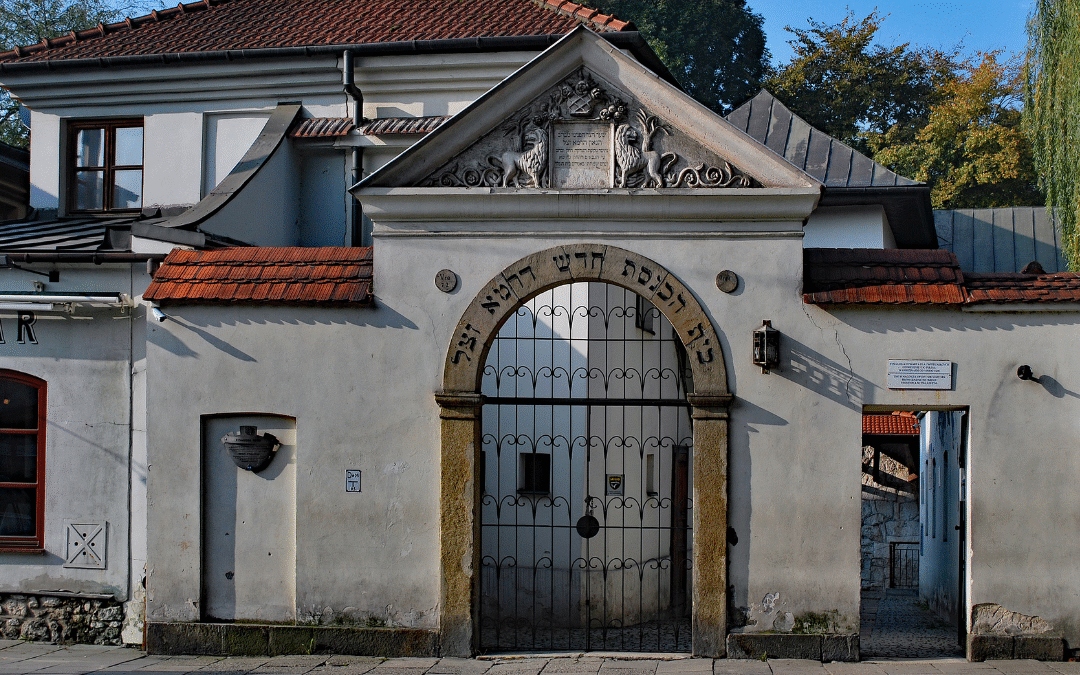
Photo Caption: The gate of the Remuh Synagogue and Cemetery in Kraków’s Kazimierz quarter — a fitting image for the 2026 Jewish Culture Festival theme, “Sha’ar | The Gate,” and for a new era of Polish Jewish community and connection. Photo: Zygmunt Put, Wikimedia Commons, CC BY-SA 4.0; cropped/resized from original.
.
Roots & Revelations: Field Notes is a monthly series from L’Dor V’Dor Foundation exploring Jewish heritage, memory, and the stories we carry forward.
How community renewal, archives, AI, and genealogy tools are helping families reconnect with Jewish Poland
A Family Recipe, a Whispered Truth
In 2006, Rabbi Harry Levin, Rabbi Gustavo Kraselnik, and Rabbi David Sperling traveled to Warsaw to help people seeking to reclaim, affirm, or enter Jewish life. They expected questions about Judaism. What they found were also family stories – some whispered, some half-remembered, some carried for decades without a name.
“One woman told us that every Easter her mother made a special dish of chopped apples and walnuts. Of course, it was kharoset!”
— Rabbi David Sperling
The rabbis recognized the dish immediately: kharoset, the Passover food of memory and liberation. In one Polish family, it had survived as an Easter dish, a custom without a name.
In another family, a grandmother waited until her deathbed to tell her grandson that she was Jewish. One sentence changed the meaning of his mother’s life, his own identity, and the questions his family would ask next.
These stories do not begin neatly. They begin in kitchens, hospital rooms, whispered memories, unexplained customs, surnames, town names, and family silences that lasted for decades. What looked like disappearance was sometimes silence. What looked like loss was sometimes a thread waiting to be followed.
A Jewish Renascence
The fall of Communism across Eastern Europe in 1989 changed culture, politics, and economics. Among those changes was a new openness to religious heritage. After decades of repression, people began to think, and talk, about history and identity.
Before World War II, Poland was one of the great centers of Jewish civilization, home to roughly 3.3 million Jews. By the end of the war, about 90 percent of those Jews had been murdered. Those who survived were scattered, and many later left Poland amid postwar violence and Communist-era antisemitism.
For families who stayed, public Jewish life could be difficult, dangerous, or simply impossible. Some parents and grandparents did not tell their children they were Jewish. Some let customs survive without explanation. Some protected their children by hiding the very identity that might one day become their inheritance.
Since 1989, that silence has begun to break. Current estimates of Poland’s Jewish population vary by definition: the Institute for Jewish Policy Research estimates about 9,600 core Jews in Poland and nearly 20,000 people in its enlarged Jewish population. Numbers alone, however, do not tell the story. The real measure is found in people asking: Am I Jewish? Where did my family come from? What records survived? Who else is connected to this town, this name, this story?
A Door Opened in Warsaw
Rabbi Michael Schudrich, an American-born rabbi who has served as Chief Rabbi of Poland since 2004, has been a leader in the re-emergence of Jewish life in Poland. For many people, the first question has not been archival. It has been personal: Am I Jewish? Can I say it aloud? Is there still a Jewish community here for me?
The visiting rabbis were part of that broader context of re-emergence. As Rabbi Levin put it:
“We had no plan. We were in Warsaw and we walked into something. God opened the door.”
— Rabbi Harry Levin
The door opened at Beit Warszawa, “House of Warsaw,” a Progressive/Reform Jewish community whose roots go back to the mid-to-late 1990s. Word-of-mouth spread the news of the three visiting rabbis. People showed up with stories, documents, memories, and questions. Some suspected they had Jewish background but did not know for sure. Others knew they were Jewish, but had grown up understanding that it was dangerous, or taboo, to say so.
Stories and Revelations
“We met a renowned urologist whose grandmother told him, on her deathbed, that she was Jewish. That meant that his mother and he are Jewish. He was so moved by this revelation that he decided to become a mohel, and trained in California. On his return, he was able to make more Jews: men who had never been circumcised because their mothers didn’t want them to become targets of antisemitism.”
— Rabbi Harry Levin
A mohel is trained to perform brit milah, the Jewish ritual of circumcision. In that one story, a hidden family truth became a personal decision, a learned skill, and a way to help other Jewish men reclaim a ritual their families had avoided for survival.
The kharoset story carried the same force in quieter form. A daughter remembered chopped apples and walnuts. The rabbis heard a Passover memory. A family recipe had preserved what fear had forced underground.
Immersion for Conversion
Some of the Poles decided to affirm their Jewishness with formal conversion. A Polish television executive, who was not Jewish, loaned the rabbis his estate in Sławatycze, a town on the Bug River. He explained: “I want to do something to help the renaissance of Jews in my country.”
For the candidates, the process ended with ritual immersion in the river, a traditional final step in conversion. That first year, eight men and eleven women became members of the Jewish people, taking Hebrew names and making public a commitment that required courage, learning, and persistence.
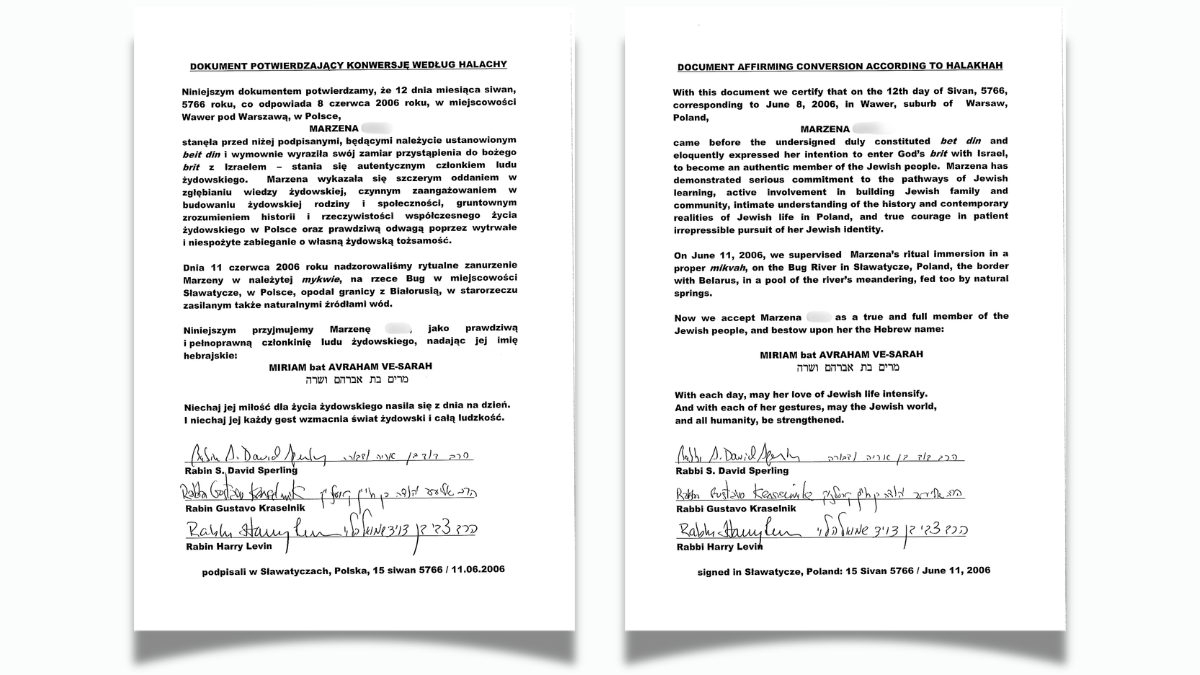
Photo Caption: Polish and English conversion certificates from the 2006 group, signed in Sławatycze, Poland, by Rabbi S. David Sperling, Rabbi Gustavo Kraselnik, and Rabbi Harry Levin. Used with permission.
.
“I was stunned by these people’s courage. Each moment of interaction in the work of conversion was a moment in the presence of someone rising emphatically beyond the constraints of tyrants.”
— Rabbi Harry Levin
“I was so impressed by how much they went through to become authentically Jewish. If I’d done this earlier in my life, I might have become a Poland-based rabbi.”
— Rabbi David Sperling
A Hotline for Jewishness
After the Holocaust, most of Poland’s remaining Jews emigrated. Chief Rabbi Schudrich has said that many Jews who stayed in Poland became silent about their Jewishness, not even telling their children.
Rabbi Schudrich has helped make Jewish life visible again. Under his leadership and alongside the work of local communities and colleagues, the signs of renewal include:
- rabbis serving communities in Kraków, Łódź, Warsaw, and Wrocław, with holiday support for other communities;
- daily prayers and Talmud study in Warsaw;
- Jewish education, including a Pre-K through high school facility;
- youth groups for teens and university students;
- and innovations like a hotline for people who suspect they might be Jewish.
Will the vibrant and pervasive Jewish life of pre-Holocaust Poland return? It is an unanswerable question, but strides are being made.
“Many cities now have more prayer and Jewish learning [opportunities] as compared to 20 years ago, or even 10 years ago. Budapest and Prague have similar yet different stories as Poland.”
— Rabbi Michael Schudrich
Jewish Identity Blooms
When I visited Poland for the first time in 2012, POLIN Museum of the History of Polish Jews was a large hole in the ground surrounded by fences with posters portraying what was to come. Situated on land that had been part of the Warsaw Ghetto, the museum’s collections preserve and recall the heritage of Jews in Poland.
POLIN opened its “1000-Year History of Polish Jews” Core Exhibition in October 2014. Since then, the museum has become a cultural must-see for students, tourists, historians, genealogists, and others interested in the long history of Jewish life in Poland.
In Kraków, the Jewish Culture Festival has presented contemporary Jewish culture since 1988 in Kazimierz, the city’s historic Jewish quarter. This year’s 35th festival, July 1-5, 2026, is themed “Sha’ar | The Gate.” That word fits this moment. A gate is a threshold between what has been hidden and what can now be entered.
While reclaiming one’s Jewish heritage is an individual decision, it is now supported and echoed by communal leaders, synagogues, museums, archives, festivals, and research tools. That is the new context for Polish Jewish identity: not only memory, but connection.
The Next Era: Connection
The first era of post-Communist Jewish renewal in Poland was about courage: families speaking aloud what had been hidden, people entering synagogues, learning Hebrew names, asking rabbis hard questions, and rebuilding Jewish community in places long associated mainly with Jewish loss.
The next era is about connection. Once someone learns, or suspects, that their family story runs through Jewish Poland, the questions become urgent and practical: Which town? Which surname? Which archive? Which newspaper, school list, yizkor book, survivor file, cemetery record, synagogue register, tax list, or handwritten civil record might still hold the thread?
LDVDF and its partners are helping build this connection layer. The goal is not to replace the institutions that have preserved Polish Jewish history for decades. It is to help descendants, researchers, scholars, archivists, and living Jewish communities find one another through the names, places, records, and stories that survived.
That work matters because Polish Jewish records are scattered across languages, alphabets, repositories, and borders. Some are digitized; many are not. Some are indexed; many remain locked inside handwritten pages. Some collections are safe; others are vulnerable. When records are surveyed, cataloged, digitized, indexed, and made easier to read, family memory becomes searchable. Community history becomes connectable.
Records-at-Risk Poland
Help rescue Polish Jewish records before they are lost
Early LDVDF DoJR pilots demonstrated how much hidden Jewish documentary heritage can still be found.
The Records-at-Risk Poland project, led by LDVDF and supported by the U.S. Commission for the Preservation of America’s Heritage Abroad, seeks to identify and describe vulnerable repositories of Jewish documentary heritage in Poland so preservation can begin before records are lost.
collections
represented
Join Us in August
This August, LDVDF will convene an online panel discussion:
A New Era of Polish Jewish Community and Connection
How community renewal, archives, AI, and genealogy tools are helping families reconnect with Jewish Poland
The program will showcase newly available and soon-to-be-released LDVDF resources for Polish Jewish research, including Polish town and regional materials in JCat’s newspaper and yizkor book catalog, a forthcoming Kingdom of Poland surname lookup expected through PastPort, the forthcoming Essentials Guide to Jewish Genealogical Research in Poland, and the LDVDF AI Lab’s historic Polish handwriting-recognition work.
Planned speakers include Jewish leaders who will bring the perspective of living Jewish community and post-Communist Jewish renewal; LDVDF’s AI Lab lead, who will demonstrate how new tools are making Polish Jewish records more searchable and usable; and invited leaders from the Jewish Historical Institute and the Polish State Archives. Final date, registration details, and speaker confirmations will be announced soon.
To receive the announcement of this and other LDVDF events: ldvdf.org/subscribe
The purpose is simple: to move from rediscovery to reconnection – from a family story to a town, from a town to a record, from a record to a person, and from that person back into the larger story of Jewish Poland.
Start Here: Resources for Polish Jewish Connection
For readers who want to begin, deepen, or support Polish Jewish research, these resources can help turn memory into connection.
If you have 10 minutes
- Orient yourself to Jewish community life in Poland today. World Jewish Congress Poland
- Learn 15 facts about Jews in Poland. Chabad.org overview
- Browse current population estimates from the Institute for Jewish Policy Research, which explains why community counts vary by definition. JPR Poland
If you have 30 minutes
- Learn about Friends of Jewish Renewal in Poland / Beit Polska, which provides opportunities throughout Poland for people seeking to learn about Judaism and Jewish life. Friends of Jewish Renewal in Poland
- Explore this year’s Jewish Culture Festival in Kraków, July 1-5, 2026, themed “Sha’ar | The Gate.” Jewish Culture Festival
- Use the FamilySearch Wiki page on Poland Jewish Records as a free orientation tool for record types and starting points. FamilySearch Wiki: Poland Jewish Records
If you want to dig deeper
- Search JCat from LDVDF. JCat Phase 1 brings together more than 10,000 Jewish newspaper and yizkor book titles, including materials relevant to Polish towns and regions. Explore JCat
- Watch for new LDVDF Polish research tools: a forthcoming Kingdom of Poland surname lookup expected through PastPort, the Essentials Guide to Jewish Genealogical Research in Poland, and the LDVDF AI Lab’s historic Polish handwriting-recognition model. Learn about the AI Lab
- Use JRI-Poland as a go-to source for indexed Jewish vital and other records from current and former territories of Poland. JRI-Poland
- Use Polish Jewish research institutions. JHI helps rebuild fragmented family stories; POLIN offers archival and genealogical research support and access, by appointment, to databases and reference materials. JHI Genealogy | POLIN Research & Genealogy
- Szukaj w Archiwach / Search the Archives, PRADZIAD, Geneteka, and Skanoteka can help researchers locate records, indexes, and scans across Polish and Jewish-specific collections. Search the Archives | Geneteka | Skanoteka
- Explore academic and Judaica resources. The Jagiellonian University Judaica Online Catalogue and similar collections can move researchers beyond vital records into books, periodicals, scholarship, and cultural history. Jagiellonian University Judaica Online Catalogue
If you want to make this possible for others
- Support Records-at-Risk Poland. Donations help fund surveys across repository types in Poland and compilation of findings before vulnerable records are lost. When donating through the U.S. Commission, indicate “Poland – Records-At-Risk” in the donation form. Donate through the U.S. Commission
- Subscribe for the August panel announcement and future LDVDF events. Subscribe to LDVDF
The Responsibility to Connect What Survived
No one can restore the Jewish Poland that was destroyed. But today, a new gate is opening: in living communities, in archives, in museums, in databases, in AI tools, and in families ready to ask the next question.
The work now is to connect what survived – and to rescue what remains at risk before more threads are lost.
Want future posts from Roots & Revelations: Field Notes and more Jewish heritage resources? Subscribe here.
LDVDF exists to help Jewish memory live. If you’re beginning or continuing a family history journey and want support recovering names, places, and stories, we invite you to connect with us, explore our resources, or get involved as a volunteer.
May their memory be for blessing, and may our remembering enhance Jewish life for generations to come.
###
About L’Dor V’Dor Foundation
The L’Dor V’Dor Foundation (LDVDF) rescues Jewish memory and makes it accessible to everyone. Through its flagship Documentation of Jewish Records Worldwide (DoJR) project, LDVDF is building JCat, a massive, free, online catalog of historical documents of Jewish lives – Ashkenazi, Sephardi, Mizrahi, Crypto‑Jewish, Rabbinic, and more. By discovering and describing every record collection we can find, LDVDF helps ensure that Jewish heritage can be found, studied, and passed from generation to generation.
Rescuing our lost history and changing lives — from generation to generation.
About the Author
Lisabeth (“Lisa”) Dashman, PhD, is a volunteer writer with the L’Dor V’Dor Foundation (LDVDF) with extensive experience in marketing communications across corporate and nonprofit organizations. Guided by a deep interest in linguistics and the way language carries culture and memory, she pursued her PhD in Anthropology alongside an MBA in Technology Management. In her monthly LDVDF posts, Lisa combines research rigor with practical storytelling to help readers preserve Jewish names, records, and family stories from generation to generation.