

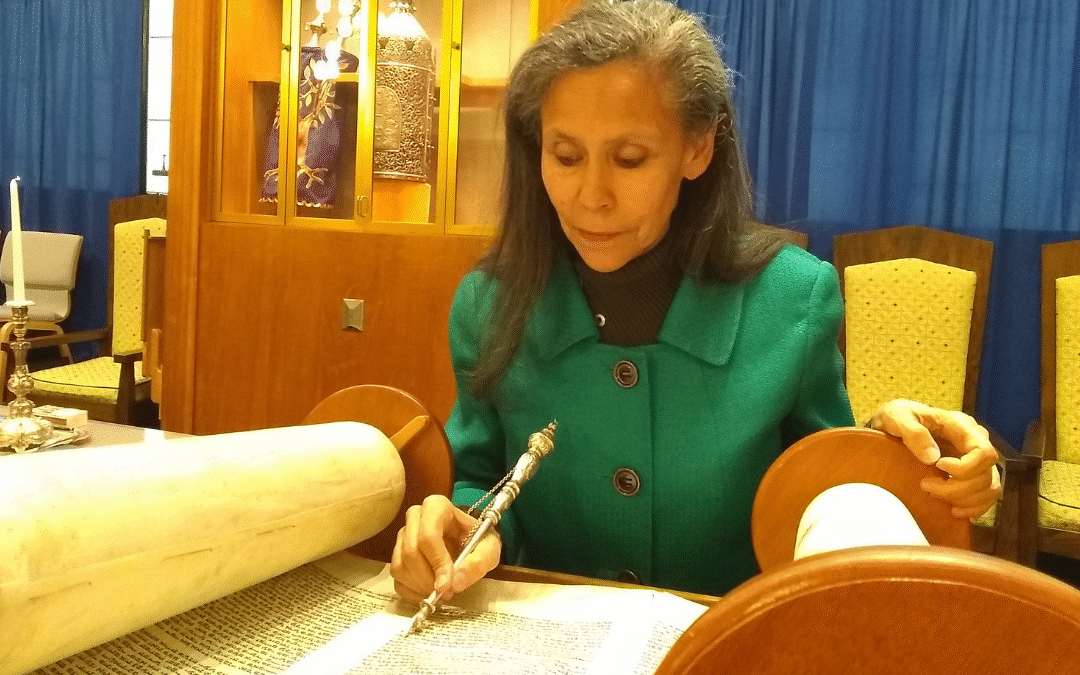
Photo Caption: Antonia Martinez chanting Kedoshim (Leviticus). She taught herself Torah cantillation. Photo courtesy of Antonia Martinez and Lisa Dashman.
Roots & Revelations: Field Notes is a monthly series from L’Dor V’Dor Foundation exploring Jewish heritage, memory, and the stories we carry forward.
There are many ways to be a Jewish American, beyond identifying as either Orthodox, Conservative, Reform, or another branch of practice. Being a Jewish American involves your unique blend of:
- Religious beliefs
- Cultural practices
- Familial traditions and ties
- Individual spirituality
- Family stories, artifacts, and memories.
Jews Who Didn’t Know They Were Jewish
One way to be Jewish is by discovering your unknown Jewish ancestors. Thousands of Americans with Spanish ancestry and brought up in the Catholic faith have discovered that they have links to a Jewish past – a past that was hidden on purpose.
These people, located in the American Southwest, Puerto Rico and other formerly Spanish colonies like Cuba and Mexico, as well as other Central American, South American, European and North African countries, are usually called “Crypto-Jews.” They are descended from conversos (Spanish, “converts”), Jews in Spain who converted to Catholicism. Some of them sincerely embraced their new religion, but many secretly kept their Jewish cultural traditions, such as food preparation rules, covering mirrors during a period of mourning, and lighting Shabbat candles. It was the task of the Holy Office of the Inquisition to find these insincere Catholics and punish them.
(A derogatory term for these “Christianized” Jews was Marrano (Spanish, “pig”), which was coined by “real” Spanish Catholics. It has gone out of favor for obvious reasons. The term Crypto-Jew is now used. “Crypto” means “hidden” in Greek.)
Research suggests there may be millions of people worldwide who are unaware of their Sephardic Jewish heritage. In Spain alone, research found that almost one in five people has genetic markers for Sephardic Jewish heritage.
Outlawing Judaism
In an effort to unify the country by making Catholicism the national religion, Spain began structured harassment against Jews (and Muslims) in 1301, escalating to arrest, torture and pogroms. In 1492, the Holy Office of the Inquisition went a step further by issuing the Alhambra Decree, which made it illegal to be a Jew.
Some conversos stayed in Spain and had to become ever more secretive. But many left, migrating to France, Italy, Netherlands, Portugal (which issued its own Edict of Expulsion in 1496), Turkey, and the Americas. Fearful of discovery, most stayed outwardly Catholic. (The Portuguese Inquisition officially ended in March 1821, the Spanish Inquisition in July 1834.)
In the late 20th century, coinciding with a growth of interest in family history and with the huge increase in internet content and access, people were able to uncover much information about their family’s history. For some, one of these areas of information was their Jewish ancestry.
Finding Puzzle Pieces – Antonia Martinez
“I had many aha moments,” says Antonia Martinez, who discovered that her Jewish ancestors migrated from Spain to the Canary Islands to Dominican Republic to Forest Hills, NY. “It was like putting together a puzzle.”
Through the years, Martinez discovered seemingly unconnected pieces of information:
- On her mother’s side, “Bencosme” (Hebrew, “son of the elder”) was a family surname. The name appeared during the Middle Ages in Spain and Portugal, and has Jewish roots.
- Although Catholic, her family had Matzah Ball Soup at Passover;
- A maternal great-grandmother christened all of her children with the legal Church name Antonio or Antonia – a tactic used to trick the Inquisition, so that when they came to a home looking for “Antonio”, the homeowner could say, “Which one? We have seven Antonios in the family.”
- Her mother did not like Catholic funerals, which include embalming and an open casket. She requested for herself that her body be washed, not embalmed, wrapped in a white cloth, and be buried in a closed, simple casket – the traditional Jewish burial process;
- Her mother’s grandfather and her father’s mother never ate pork, a very odd habit for people who lived in the Dominican Republic.
Like many other Crypto-Jews, Martinez felt an unexplainable attraction to Judaism. “My great-aunt always wore a chai. I don’t know why as she was a devout Catholic. I often looked at her chai, secretly wanting one of my own.”
Martinez learned that both sides of her family settled in Dominican Republic towns that were inland and surrounded by mountains, and that they changed their surname. The intention was to make it as hard as possible to be found by Spanish officials, if they came looking.
Hooked on Family History – Joe Maldonado
Joe Maldonado grew up in New York City, where his parents had migrated from Puerto Rico. Even as a teenager, Joe was fascinated by family history. Curiosity about his father’s surname, Maldonado Aulet, led him into deeper research. He discovered that a brother of his great-great-great-grandfather fled from Spain to Puerto Rico in the early 1800s, after a failed attempt to overthrow King Joseph Bonaparte.
“That fueled my interest in learning more and more about my family,” says Maldonado.
Like Martinez, Maldonado began collecting pieces of information:
- A genealogist told him that his mother’s surname, Marrero, had roots in Spain and the Canary Islands;
- The ancestral coat of arms for that name features Stars of David as well as Christian crosses;
- Numerous instances of intermarriage between cousins in his ancestral family, something that the Catholic Church prohibited, but that could occur by obtaining a “dispensation of consanguinity”;
- In Puerto Rico, his mother’s hometown of Utuado is located in an isolated and mountainous inland region;
- Many household routines unusual for Christians, such as sweeping to the center of a room; burying the dead within 24 hours; covering mirrors, staying at home for 7 days and nights, and receiving visitors after a burial while saying the rosary; insisting on using rock salt and following a strict procedure to discard the blood when slaughtering a chicken; and not having meat and dairy products in the same meal. When he asked why, the answers were along the line of “That’s just what I was taught to do.”
A Transformative Moment
In 2015, while at a conference in Netanya, Israel, Maldonado went to a Shabbat service for the first time. Something clicked into place for him, and back in New York he began a new research project: to officially return to his Jewish heritage, known in Hebrew as teshuvah.
He completed the journey in 2016. “The genetics and the genealogy are important, but so are traditions, customs, and other family factors,” he says of the journey. “Genetic testing and digitizing of documents are making family research and discovery available to everyone.”
A Surprising Diagnosis
In another hard-to-get-to location — the San Luis Valley in south-central Colorado and north-central New Mexico between the San Juan Mountains and the Sangre de Cristo Mountains — genetic counselors studied the DNA of some Hispano-American patients with a form of breast cancer caused by a very specific genetic mutation. It is most often found in Jewish people from Central or Eastern Europe.
After Judaism was outlawed in Spain and Portugal, some Crypto-Jews ended up in Mexico. Later, some of them moved north to areas that became New Mexico and Colorado. Hundreds of years later, the diagnosis of the disease caused by the genetic mutation in non-Jewish patients doesn’t prove they have Jewish ancestry — but it is certainly suggestive.
The Secret Revealed
In early 2008, an aunt finally revealed to Antonia Martinez a long-held secret: the family is Jewish, descended from Crypto-Jews who left Spain in 1492 because of the Inquisition, lived in the Canary Islands, and later settled in Dominican Republic. Later that year, Martinez completed her teshuvah to Judaism with a ceremony that included taking a Hebrew name.
“I selected the name Yocheved,” Martinez says. “It means ‘God’s glory’, and I find it a glorious thing to be able to reclaim my ancestral heritage after 516 years.”
What This Means for the Roots-Curious
The story of Crypto-Jewish heritage offers a powerful reminder: identity is not always a straight line. Sometimes it is a return. Sometimes it begins with a housekeeping habit, a repeated name, an old necklace, a burial custom, or a question no one thought to ask.
A clue is not a conclusion. But asking the question can be meaningful. Sometimes all it takes is an act of listening: to elders, to records, to inherited customs, and to the names that still connect one generation to the next.
Resources
If you have 10 minutes:
- Type “family history research methodology” into YouTube.com or a search engine to find a helpful webinar.
- Ask a parent or grandparent or other relative if someone in your family lights candles on Friday night or has some other typically Jewish routine that others in the family don’t.
If you have 30 minutes:
- Explore the website of the Society for Crypto-Judaic Studies, whose mission is to foster research into the historical and contemporary development of Sephardic Crypto-Jews.
- For the status of archival records in a variety of locations worldwide, read Genie Milgrom’s “The Jews Who Did Not Leave Spain and Portugal”. (If you are not already a member of the International Institute for Jewish Genealogy and Paul Jacobi Center, you will first need to register for free.)
- Browse the websites of Kulanu (Hebrew, “all of us”) and The Sephardic Jewish Brotherhood for information, ways to get involved, and offerings for all age groups.
- Search the remarkable data on Genie Milgrom’s website relating to conversos and Crypto-Jews, including more than 80,000 searchable names.
If you want to dig deeper:
- Genie Milgrom, How I Found My 15 Grandmothers: A Step by Step Guide. Seattle, WA: CreateSpace Independent Publishing Platform, 2014. – See Chapter 8 for a rich assortment of websites for doing online research.
- Stanley M. Hordes, To the End of the Earth: A History of the Crypto-Jews of New Mexico, New York: Columbia University Press, 2005 –Written by a University of New Mexico professor and former New Mexico State Historian, this book examines more than 500 years of hidden Jewish culture, both in Europe and the “New World.”
Want future posts from Roots & Revelations: Field Notes and more Jewish heritage resources? Subscribe here.
LDVDF exists to help Jewish memory live. If you’re beginning or continuing a family history journey and want support recovering names, places, and stories, we invite you to connect with us, explore our resources, or get involved as a volunteer.
May their memory be for blessing, and may our remembering enhance Jewish life for generations to come.
###
About L’Dor V’Dor Foundation
The L’Dor V’Dor Foundation (LDVDF) rescues Jewish memory and makes it accessible to everyone. Through its flagship Documentation of Jewish Records Worldwide (DoJR) project, LDVDF is building JCat, a massive, free, online catalog of historical documents of Jewish lives – Ashkenazi, Sephardi, Mizrahi, Crypto‑Jewish, Rabbinic, and more. By discovering and describing every record collection we can find, LDVDF helps ensure that Jewish heritage can be found, studied, and passed from generation to generation.
Rescuing our lost history and changing lives — from generation to generation.
About the Author
Lisabeth (“Lisa”) Dashman, PhD, is a volunteer writer with the L’Dor V’Dor Foundation (LDVDF) with extensive experience in marketing communications across corporate and nonprofit organizations. Guided by a deep interest in linguistics and the way language carries culture and memory, she pursued her PhD in Anthropology alongside an MBA in Technology Management. In her monthly LDVDF posts, Lisa combines research rigor with practical storytelling to help readers preserve Jewish names, records, and family stories from generation to generation.