

In this post, we clear up three surname myths and suggest some ways to discover the truth about your surname – l’dor v’dor, from generation to generation.
Myth #1: Ellis Island Officials Changed Names
Have you heard the joke about how names were changed at Ellis Island? A man is standing in front of a clerk, who asks him to state his name. Exhausted and bedraggled from his voyage, the man answers, “Shoyn fergesn” (Yiddish, “I have already forgotten”). But the clerk hears “Sean Ferguson”, writes it down, and the man officially becomes named Sean Ferguson.
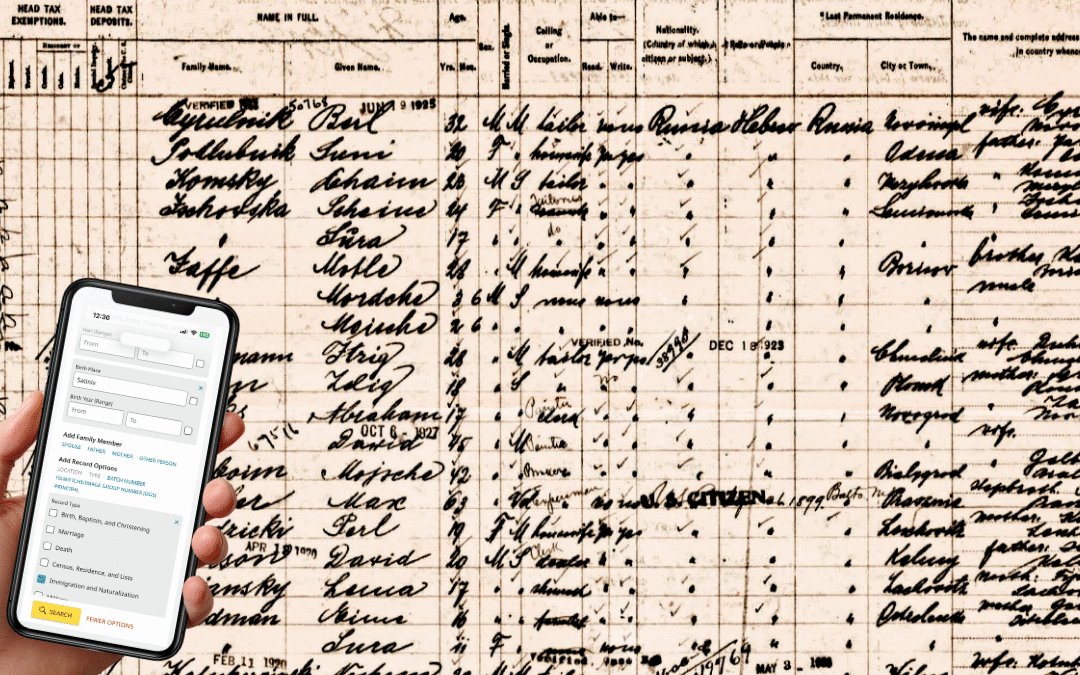
This is a myth. The fact is the clerk would have in front of him the ship manifest, the document that lists each passenger, including details like age, occupation, and where they last resided. The manifest was created at the port of departure – not at Ellis Island or wherever the ship docked. The clerk had to match a name on the ship manifest with the passenger standing in front of him.
What Happened Before Surnames?
For much of Jewish History, a permanent, inheritable surname was not the norm. People were identified in ways that made sense to the local community. Common patterns included:
- Patronymics (Rebekkah daughter of Abraham) or matronymics (Efraim son of Malka).
- Place names (Samuel of Rottweil, Isaac from Sweden).
- Personal characteristics (Moses the Red Beard, Bella the Short)
- Occupations (Leah the Weaver, Adam the Cobbler).
- Acronyms. Rashi (which stands for Rabbi Shlomo Yitzhaki, where “Yitzhaki” refers to his father’s name, hence Rabbi Shlomo son of Yitzhak) and Rambam (Rabbi Moses ben Maimon, aka Maimonides). A more common example is the surname Katz (Kohen Tzedek, “Righteous priest”).
In these systems, the surname belonged to the individual only. It did not continue to identify the next generation.
Why Fixed Jewish Surnames Became Standard in Europe
For many Jewish communities—especially Ashkenazi Jews in Central and Eastern Europe—traditional naming patterns made official recordkeeping difficult. Governments needed more reliable ways to identify residents for tax collection, military service, and civil administration, so they passed laws requiring Jews to adopt fixed, inheritable surnames. The Habsburg Empire did so in 1787, France in 1808, and Prussia in 1812, and over the course of the 19th century similar laws spread across much of Europe. By the end of that century, permanent family surnames had become the norm.
This timeline, however, was not universal. Many Sephardic Jews had already been using hereditary family names centuries earlier, especially in medieval Iberia, where surnames often developed gradually within Iberian and Mediterranean society rather than being imposed later by government decree.
Once fixed surnames became necessary, families adopted them in several ways. One common approach was to turn a patronymic into a hereditary surname in the local language. Thus, “David son of Abram” could become David Abramsohn in German, David Abramovich in Russian, or David Abramovici in Romanian. In my own family, the surname “Gisser,” a shortened form of “Zinngiesser,” suggests that one of my ancestors may have been a pewter craftsman.
Another common pattern was to create a surname from a place name, often by adding suffixes such as -ski in Slavic languages or -er in German. My husband’s grandfather took the name “Dashevsky,” from Dashev, because the family lived in Dashev, in Kiev Province of the Russian Empire.
Myth #2: Pretty Names Were For Sale
If a person couldn’t or wouldn’t choose a surname, a government agent would do it for them. Some historians claim that for the right price, your surname became Mandelbaum (German, almond tree) or an equally pleasant name. Without a bribe, your surname could be Bolotin (Russian, swamp) or worse.
This assumes that clerks all over Europe and beyond took part in this systemic bribing – a highly unlikely theory. Focus on records, not legends.
Myth #3: People with the same surname are related
Wouldn’t that make researching your family so much easier? Unfortunately, it’s completely groundless. The surname could indicate a long-past occupation (Carpenter, Smith, Miller, etc.) or heritage place of residence (Wiener, from Vienna; Moscovitch, from Moscow) or it could be a name that appealed to the ancestor or to the clerk that assigned it.
The Real Headache: Spelling, Alphabets, and Metamorphoses
One of the things that make tracing Jewish ancestors so exasperating is the inconsistent spelling of family names. It’s not uncommon to discover:
- Conflicting spellings on census forms, ship manifests, birth certificates, school records, and/or other documents. My mother’s maiden name, which was standardized to Gumbrecht by the 1920s, is also found as Gumbresht, Gumbrich, Gumprecht, Gumrech, and Gumbrocht.
- A name change adopted by an ancestor without officially registering it. In my husband’s family, “Dashevsky” metamorphosed into “Dashman” sometime between the 1910 and 1920 U.S. Censuses.
- A best-guess interpretation of a handwritten document when it was transposed to a typed or digital format.
- A mistake that substituted one letter for another, especially when converting one language’s alphabet to another.
A practical rule: search for sounds as well as spellings. Keep a list of variants, and write down any towns connected to each version of the name.
These three myths are not the only obstacles to tracing the origin of a surname – and we haven’t even begun to discuss name changing. (That will be the focus of a future post.) If you want to pursue the history of your surname, listed below are some ways to begin. But remember this fact from surname scholar Alexander Beider: “There is no finite list of ‘Jewish surnames’. A ‘Jewish surname’ is simply any name borne by a Jew.”
Do you have a story about a family name? Share it with us!
If you have a family name story (or a mystery you’re trying to solve), share it with us using our story form . Every name we recover – and every story we preserve – strengthens the chain of Jewish memory.
A Surname Starter Kit: Do This Today
If you have 10 minutes:
- Write your surname and two variants (even “wrong” spellings count)
- Check out the surnames compiled by region – Ashkenazic https://stevemorse.org/phonetics/beider.php
Sephardic https://stevemorse.org/phonetics/faig.php
If you have 30 minutes:
- Search your surname in the JewishGen Family Finder https://www.jewishgen.org/jgff/, a tool to find other people who are researching the same surname as you.
- Consult the Avotaynu Consolidated Jewish Surname Index https://www.avotaynu.com/csi/csi-home.htm a tool that provides alternate spellings as discovered in more than 40 different databases.
If you want to go deeper:
- Ask an older relative about the surnames in your family. A good question to start with might be, “Where did the name ___ come from?” or “Did anyone in our family change their last name?”
- Examine naturalization records for your family. This is often when your relative may have officially recorded a change to their name.
- Onomastics expert Alexander Beider, a global authority on Jewish names, has published a series of in-depth surname dictionaries by region (Galicia; Russian Empire; Kingdom of Poland; Maghreb, Gibraltar and Malta; among others).
More resources:
- Explore our Global Name Sources — a country-by-country guide to archives, databases, and Jewish genealogy resources for researching surnames, migration records, adoption records, and documented name changes across the Jewish diaspora.
LDVDF exists to help Jewish memory live. If you’re beginning or continuing a family history journey and want support recovering names, places, and stories, we invite you to connect with us, explore our resources, or get involved as a volunteer.
May their memory be for blessing, and may our remembering enhance Jewish life for generations to come.
###
About L’Dor V’Dor Foundation
The L’Dor V’Dor Foundation (LDVDF) rescues Jewish memory and makes it accessible to everyone. Through its flagship Documentation of Jewish Records Worldwide (DoJR) project, LDVDF is building JCat, a massive, free, online catalog of historical documents of Jewish lives – Ashkenazi, Sephardi, Mizrahi, Crypto‑Jewish, Rabbinic, and more. By discovering and describing every record collection we can find, LDVDF helps ensure that Jewish heritage can be found, studied, and passed from generation to generation.
Rescuing our lost history and changing lives — from generation to generation.
About the Author
Lisabeth (“Lisa”) Dashman, PhD, is a volunteer writer with the L’Dor V’Dor Foundation (LDVDF) with extensive experience in marketing communications across corporate and nonprofit organizations. Guided by a deep interest in linguistics and the way language carries culture and memory, she pursued her PhD in Anthropology alongside an MBA in Technology Management. In her monthly LDVDF posts, Lisa combines research rigor with practical storytelling to help readers preserve Jewish names, records, and family stories from generation to generation.